Electro-Hydraulic Steering Gear System: Practical Learning at IMI (BTech Batch 18)
Modern ships and heavy machinery depend on systems that can manage large forces while remaining safe, precise, and easy to control. A key example is the hydraulic steering gear system. For marine engineering students, understanding how such systems work is essential, and applying this knowledge through hands‑on development significantly strengthens practical learning.
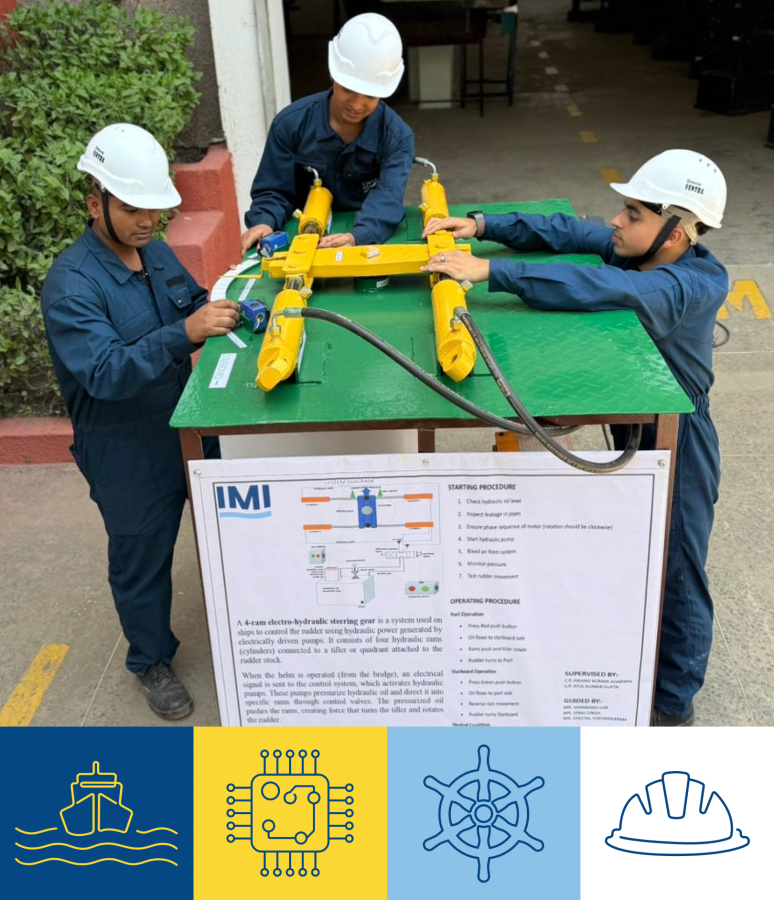
Cadets Arsh Chambyal, Avinash Kumar, and Prince Kumar from IMI’s BTech Batch 18 have designed, assembled, and demonstrated a working model of an electro‑hydraulic steering gear system. Their project clearly shows how classroom theory can be translated into a functional and operational engineering setup.
About the Project
The cadets developed a working electro‑hydraulic steering system model replicating the existing systems commonly used on ships and heavy‑duty machinery. The system is to demonstrate the uses of pressurised hydraulic oil to operate the steering mechanism, allowing controlled and smooth movement to be demonstrated effectively.
As Arsh Chambyal explains, “the system replaces heavy manual effort with hydraulic power, making steering quicker, more efficient, and easier to manage. In simple terms, it enables the ship’s rudder to be turned using pressurised fluid, an essential function, as rudders must overcome strong water resistance.”
The project effectively illustrates a core engineering principle: electrical signals are used to control hydraulic flow, allowing a small input force to manage a much larger output force. This concept is fundamental to safe and accurate ship steering systems.
How Does It Work?
The working model is designed to operate in the same manner as a ship’s electro‑hydraulic steering gear, clearly demonstrating how the system functions through a well‑defined sequence. An electric motor drives a hydraulic pump, generating pressure and pushing oil through pipelines. This pressurised oil enters hydraulic cylinders, or rams, causing them to move back and forth. The resulting motion is transmitted through a shaft and tiller arm, which rotates the rudder and changes the direction of movement.
In summary: Electric energy → Hydraulic pressure → Mechanical movement → Steering
Main Components
The system consists of several key components working together. A 1 HP electric motor powers the hydraulic pump, which generates oil pressure. The oil is directed to four hydraulic rams that produce movement. A control valve manages the direction of flow, enabling movement to port or starboard. A relief valve maintains safe pressure levels, while a pressure gauge displays operating conditions. A limit switch ensures the system does not exceed its designed range of motion.
Avinash Kumar: “The system delivers smooth and controlled steering with minimal effort. Its robust design can handle heavy loads, making it suitable for both marine and industrial applications. Built-in safety features further protect the system and its users.”
Prince Kumar: “During testing, our system performed steadily and reliably. A full steering cycle was completed in approximately 23 to 24 seconds. The system generated adequate force and showed negligible oil leakage, indicating careful assembly and effective sealing.”
Safety Measures and Future Improvements
Safety was a key focus throughout the project. The relief valve prevents excessive pressure build-up, while the limit switch avoids overextension of the rams. A strong supporting structure also reduces the risk of mechanical failure.
Looking ahead, the cadets intend to introduce an automatic steering feature would improve precision, while a backup hydraulic pump could increase reliability. The addition of digital sensors may allow better monitoring of pressure and early fault detection.
This project demonstrates how engineering theory can be effectively applied in practice. By designing and testing a working hydraulic steering system, the cadets have shown both technical understanding and practical skill, key qualities for a career in marine engineering.
Congratulating the team, Capt Saurabh Varshney, HOI, IMI, remarked:
“This project reflects the strength of hands-on learning at IMI. By building and testing real systems, our cadets develop not only technical knowledge but also the confidence and practical skills required for modern marine engineering.”
 World Maritime Day 2026 at IMI: From Policy to Practice, Powering Maritime Excellence
  IMI Cadets Attend Sagar Samvad 2026
  IMI Celebrates 80th Independence Day with Fervour, Patriotism and Maritime Pride
  B.Tech 22 and DNS 45 Orientation Session at IMI
  Building Resilient Cadets for Successful Maritime Careers


 VIRTUAL TOUR
 WhatsApp